
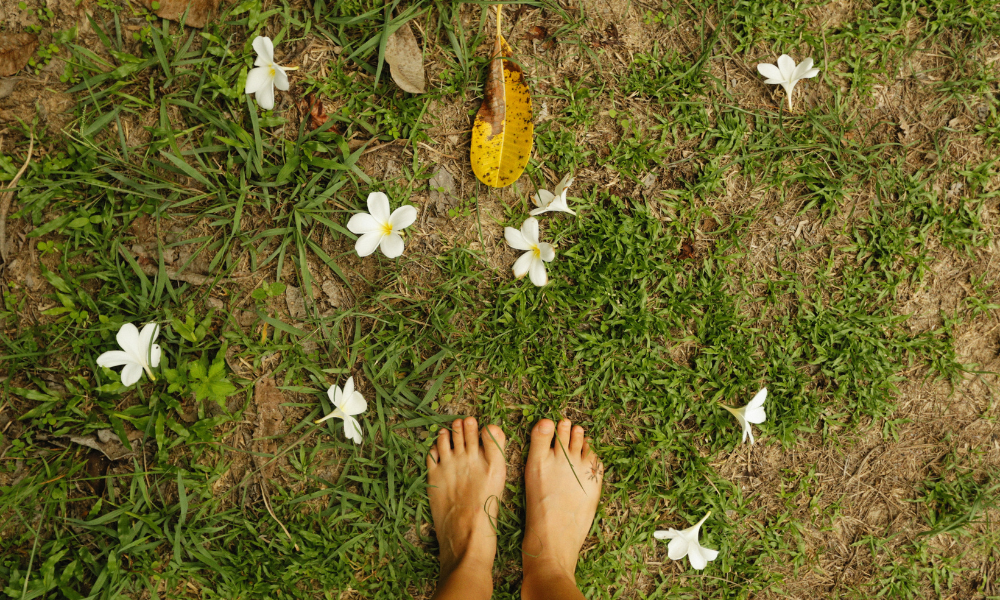
Do you ever feel like you need to ground yourself after watching the morning news or scrolling through social media? In grounding, we reaffirm that the present moment is all that is. We bring ourselves into the ‘now’ and seek to embrace a joyful presence.
When we are not grounded, we often feel stressed or anxious, focusing on unpleasant memories or worries about the future. I often share grounding techniques in my mental health counseling practice. Grounding is important for my own wellness.
Here are eight ways to ground yourself:
1. Box Breathing
Grounding may sound like something New Age, but box breathing is famously used by U.S. Navy SEALs to maintain composure in high-stress environments (Cleveland Clinic, 2025). Taking slow, deep breaths is a powerful physiological reset.
Box breathing involves the following simple technique:
- Inhale slowly while mentally counting to four.
- Hold your breath while counting to four.
- Exhale slowly while counting to four
- Repeat until you feel calm.
Box breathing allows you to manually stimulate the Vagus nerve. This signals your brain to switch from the “fight-or-flight” stress response to the parasympathetic nervous system’s “rest and digest” state (Cooney, 2015).

2. The 5-4-3-2-1 Technique
Observe the following to bring yourself calm and back into the present:
- 5 things you can see.
- 4 things you can hear.
- 3 things you can feel.
- 2 things you can smell.
- 1 thing you can taste.
This technique is clinically recognized for its ability to pull the brain out of the “default mode network” (where rumination and worry occur) and into the “task-positive network,” which focuses on immediate sensory data (Mayo Clinic, 2023).
3. Sensory Anchors: Bells, Incense, and Aromatherapy
Sensory anchors such as bells, incense, or aromatherapy pull your focus back to the immediate environment. These tools create a sensory-rich atmosphere that encourages the mind to settle into the present moment.
4. The Name Game
Name as many items as you can see right now in one minute. This exercise provides an immediate cognitive shift that can break a cycle of anxious thoughts (Ellington, 2025).
5. Acts of Service or Charity
Engaging in acts of service or charity is a profound way to ground yourself. Shifting your focus toward the needs of others through tangible actions can provide a sense of purpose, agency, and connection to your community.
7. Reconnecting with Nature
There are many grounding methods that involve connecting with nature in the present moment. These include walking, especially in nature. “Earthing”—walking barefoot on grass, sand, or soil.
Sometimes a short walk can hit the reset button on stress. Stanford researchers found that walking in nature leads to a significant decrease in the area of the brain associated with depression and brooding.
A study published in the Journal of Environmental and Public Health suggests that “Earthing” (direct physical contact with the Earth’s surface) can reduce cortisol levels and inflammation. To try Earthing, walk barefoot on grass, sand, or soil.
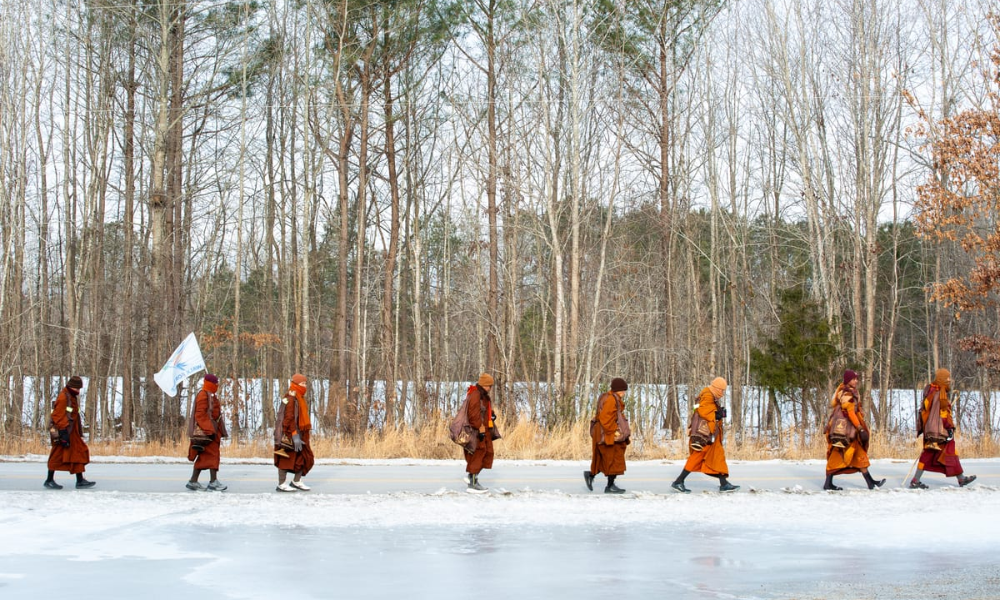
Nearly two dozen Buddhist monks on their 2,300 mile Walk for Peace (Photo by Max Posner)
8. Mindfulness: Grounding Yourself by Fully Experiencing the Present
To use mindfulness to ground yourself, pay very close attention to an action or observation you’re doing at the moment. For example, observe the presence of a particular color like the blue of the sky.
Eat and drink while paying attention to every second of that experience and how it feels to your mouth and hand. Wash the dishes while focusing solely on the task, without distraction.
This practice is beautifully illustrated by a Walk for Peace a dozen Buddhist monks undertook recently from Texas to Washington D.C. In 1982, I had the opportunity to spend time with Japanese Buddhist monks on a similar walk for peace.
At that time in 1982, I lived in a shared house with other members of the Fellowship of Reconciliation, an interfaith movement devoted to nonviolence, peace, and reconciliation. One morning, I came downstairs for breakfast and found myself sitting at the table with Japanese Buddhist monks! They were on a peace pilgrimage, carrying their message one mindful step at a time.
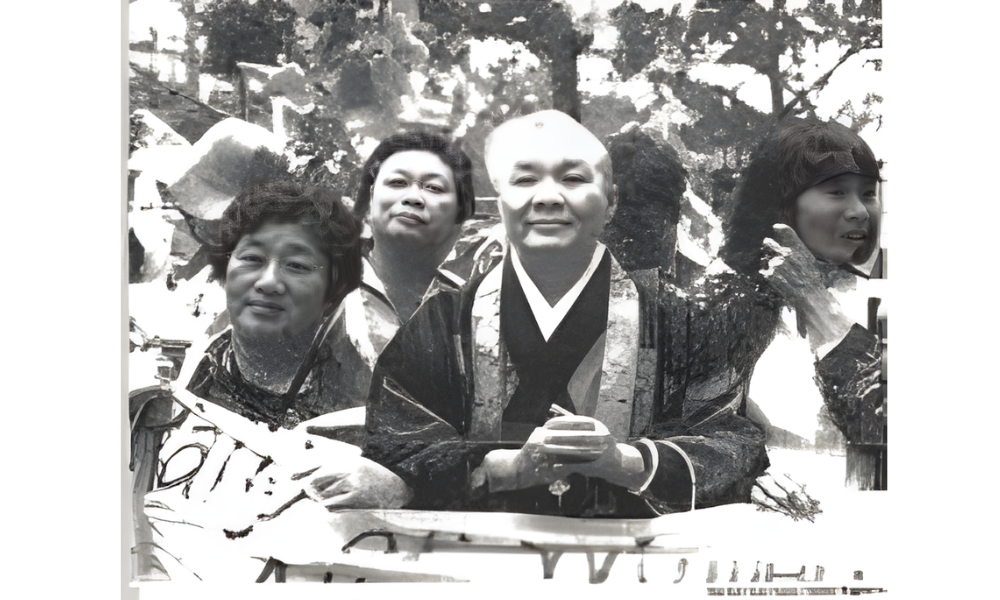
Japanese Buddhist Monks on their walk for peace on June 8, 1982 (Photo: New York Times)
When I mentioned that I was leaving to get bread from the Catholic Monastery of the Holy Spirit, the Japanese monks immediately asked if they could come! I told them I was going to see Catholic monks, but their enthusiasm didn’t wane for a second.
Father Tom, a Catholic priest, welcomed the Japanese monks with kindness and hospitality. Father Tom offered the monks a picture of Jesus. In return, they gave him a picture of the Dalai Lama.
The message we learn from both Walks for Peace is to continue a commitment to live in this moment with each action, step, or word. Gandhi’s quote, “Be the Peace that you wish to see in the World,” is the message we can strive for every day.
Healing, whether personal or collective, does not happen all at once. It happens step by step, choice by choice, and moment by moment.
Are you struggling to find calm in a chaotic world?
While these techniques are powerful tools for self-regulation, sometimes the brain needs help staying in a state of calm. Neurofeedback and Biofeedback can help “wire” your brain for lasting resilience and peace. If you would like support, please reach out through our contact form below or:
Call 678-210-1166
Email doctors@anchorpointga.com

Written by Dr. Susan A. Sendelbach, M.A., D.Min.
Resources
5-4-3-2-1 Technique (Sensory Grounding) Mayo Clinic Health System. (2023, July 13). 5, 4, 3, 2, 1: Countdown to take control of anxiety. https://www.mayoclinichealthsystem.org/hometown-health/speaking-of-health/tips-to-help-ease-anxiety
Box Breathing and the Vagus Nerve
Cleveland Clinic. (2025, February 19). Interoception: Definition, symptoms & how to improve. https://my.clevelandclinic.org/health/articles/interoception
Cooney, E. (2015, April 16). Breath taking: Sensory neuron subtypes control different respiratory functions. Harvard Medical School. https://hms.harvard.edu/news/breath-taking
Nature Therapy and “Earthing”
Bratman, G. N., Hamilton, J. P., Hahn, K. S., Daily, G. C., & Gross, J. J. (2015). Nature experience reduces rumination and subgenual prefrontal cortex activation. Proceedings of the National Academy of Sciences (PNAS), 112(28), 8567–8572. https://doi.org/10.1073/pnas.1510390112
Chevalier, G., Sinatra, S. T., Oschman, J. L., Sokal, K., & Sokal, P. (2012). Earthing: Health implications of reconnecting the human body to the Earth’s surface electrons. Journal of Environmental and Public Health, 2012, Article 291541. https://doi.org/10.1155/2012/291541
The “Name Game” and Cognitive Redirection
Ellington, A. (2025, November 20). Using CBT grounding exercises: What they are and when to use them. Beck Institute for Cognitive Behavior Therapy. https://behavioralhealthservicesogc.com/uncategorized/using-cbt-grounding-exercises-what-they-are-and-when-to-use-them/
Mindfulness and Neuroplasticity
Hölzel, B. K., Carmody, J., Vangel, M., Congleton, C., Yerramsetti, S. M., Gard, T., & Lazar, S. W. (2011). Mindfulness practice leads to increases in regional brain gray matter density. Psychiatry Research: Neuroimaging, 191(1), 36–43. https://doi.org/10.1016/j.pscychresns.2010.08.006
Acts of Service and “The Helper’s High”
Dossey, L. (2018). The helper’s high. Explore: The Journal of Science & Healing, 14(6), 393–399. https://doi.org/10.1016/j.explore.2018.10.003
Piferi, R. L., & Lawler, K. A. (2006). Social support and ambulatory blood pressure: An examination of both receiving and giving. International Journal of Psychophysiology, 62(2), 328–336. https://doi.org/10.1016/j.ijpsycho.2006.06.002